Vehicle Branding Strategies: Boosting Delivery Van Visibility for Food Brands
As a veteran automotive wrap blogger, I track the rapid evolution of mobile out-of-home (OOH) media. Recently, I noticed a massive shift in how culinary companies view their transport assets. Today, smart business owners use high-impact vehicle branding on standard commercial delivery van fleets. Consequently, these vehicles act as 24/7 rolling billboards. They easily generate anywhere from 30,000 to 70,000 daily visual impressions. Therefore, food and beverage brands operating in hyper-competitive markets must transform everyday transit routes into high-end visual showcases. In this article, we will break down exactly how modern wraps achieve these spectacular results.

Why Vehicle Branding is Vital for Modern Fleets
When you evaluate marketing costs, mobile assets deliver unparalleled local reach. For instance, industry data shows that mobile graphics average a cost per thousand impressions (CPM) of under $0.48. Meanwhile, static billboard rentals cost thousands of dollars each month. Therefore, the business case for wraps becomes clear immediately.
However, before you start your mobile marketing journey, you must understand your options. It is highly beneficial to look at the differences between Full vs. Partial Wraps to see which coverage level best matches your current operational budget.
| Advertising Medium | Estimated CPM | Audience Retention Lifespan |
| Mobile Graphics | $0.48 | Up to 5–7 Years (Vinyl Life) |
| Traditional Billboards | $3.56 | 4 Weeks (Standard Flight) |
| Radio Advertisements | $7.75 | 30 Seconds |
| Print Magazine Ads | $21.46 | Single Issue |

Case Study: The Premium Cold-Brew Fleet Overhaul
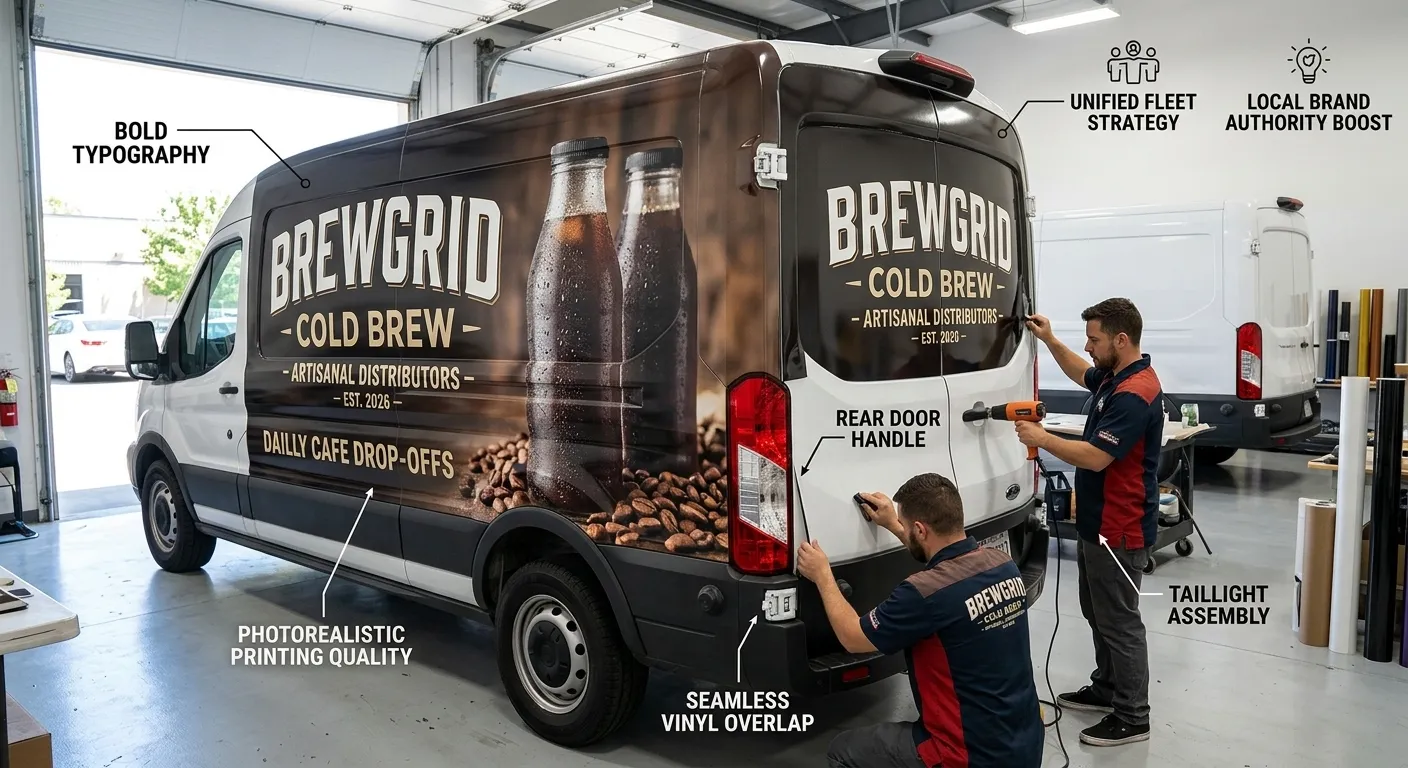
To understand why professional vehicle branding works so well, let’s examine a recent regional project. A local artisanal beverage distributor operated a modest fleet of five white Transits. Initially, these vehicles hauled daily cafe drop-offs across a major metropolitan grid. Furthermore, the truck panels were entirely blank, which meant they wasted valuable ad space.
Our main objective was to implement a unified fleet strategy. Specifically, we prioritized bold typography and photorealistic printing quality to boost local brand authority.
Blank Fleet Paint ──> HD Cast Vinyl Application ──> 16 Million Annual Impressions/Car

The Design Strategy
The beverage company prided itself on its clean ingredients and premium price point. Therefore, standard flat-color lettering was out of the question. Instead, we designed a full-coverage wrap featuring a matte charcoal background. In addition, we embedded subtle, dark textures of coffee plant foliage into the base layer. The stunning focal point featured a high-definition, glossy graphic of condensation-covered glass bottles.
This contrast proved crucial when the delivery van parked outside busy downtown office complexes. Passersby noticed the premium vehicle branding immediately. As a result, instead of seeing a generic utility truck blocking the alley, consumers saw a curated luxury installation.
Technical Challenges of Vehicle Branding on a Commercial Delivery Van
From a technical installation perspective, executing flawless vehicle branding requires a master-level understanding of material physics. Unlike a standard sedan, an industrial commercial delivery van features major structural hurdles. These obstacles can easily ruin a poorly planned design. To ensure maximum durability, top shops strictly utilize premium, weather-resistant vinyl casting films. For example, they trust industry-certified materials like 3M Commercial Graphics.

- Corrugation and Deep Recesses: The side panels of a commercial vehicle contain deep structural recesses. Manufacturers stamp these shapes into the metal to prevent panel vibration. However, inferior promotional vinyl will bridge over these gaps and eventually pop. Therefore, installers must use high-grade cast vinyl and specialized heat-forming tools to mold the material deeply into every valley.
- Rivets and Panel Seals: Cargo vehicles take a beating daily. Consequently, they feature hundreds of raised rivets and rubber weather stripping around the rear doors. Installers must meticulously trim, squeegee, and post-heat every piece of graphics to permanently kill the vinyl’s “memory.”
- Door Handles and Lock Cylinders: Keyholes and heavy-duty latch handles require absolute precision. Thus, premium execution means wrapping tightly behind the hardware housing. This technique prevents the original factory paint from peeking through.
Designing High-Impact Vehicle Branding for Speed
When implementing your mobile layout, you must remember that your target market is moving constantly. An in-car audience or a pedestrian crossing a busy intersection has very little time. On average, they have only 2.5 to 3 seconds to process your rolling message.

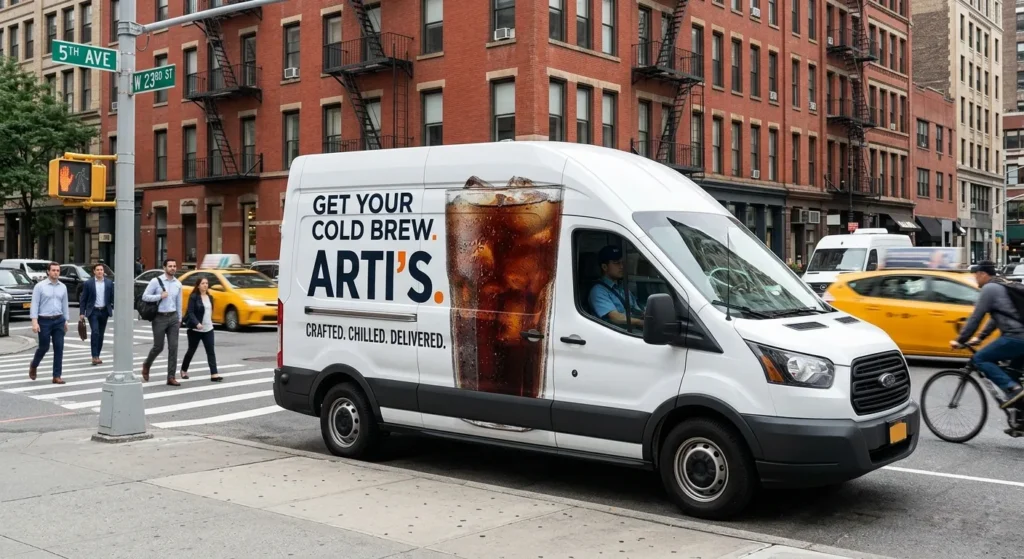
Consequently, the golden rule of fleet design is simple: do not overcomplicate the layout. A successful delivery van wrap needs exactly three core components. First, display a highly recognizable logo. Second, add a clear three-word value proposition. Finally, include a direct call to action, such as a clean web URL.t Cold Brew”), and a direct call to action like a clean web URL or a short social handle.
The Ultimate ROI Checklist for Food & Beverage Companies
If you want to deploy your fleet as a primary marketing tool, use this checklist before signing off on your final production proofs:
- Does the color palette respect the vehicle context? If your vehicle has an external refrigeration unit, make sure your background graphics blend into these mechanical elements seamlessly.
- Is the text placed well above the mud line? Always keep your website, phone numbers, and core logos on the upper two-thirds of the panels. Otherwise, road grime and mud during winter months will completely obscure your print.
- Are the graphics scaled to the physical body lines? Make sure critical information does not cross over an active door seam. Furthermore, avoid sliding door tracks and tail-light hinges so your text never gets cut in half.
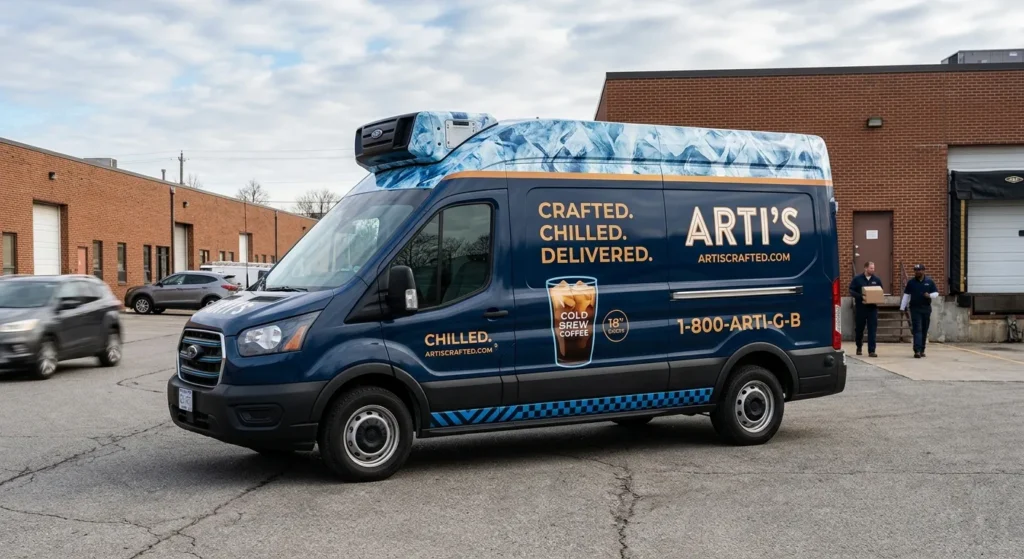
Ultimately, investing in professional vehicle branding turns an unavoidable overhead cost into an active, highly scalable customer acquisition channel. Every mile your delivery van travels is a direct handshake with a potential consumer. Therefore, you must make sure your vehicle is dressed for the occasion.